Painting Tips
How do I get rid of old paint?
- Marty Dukes
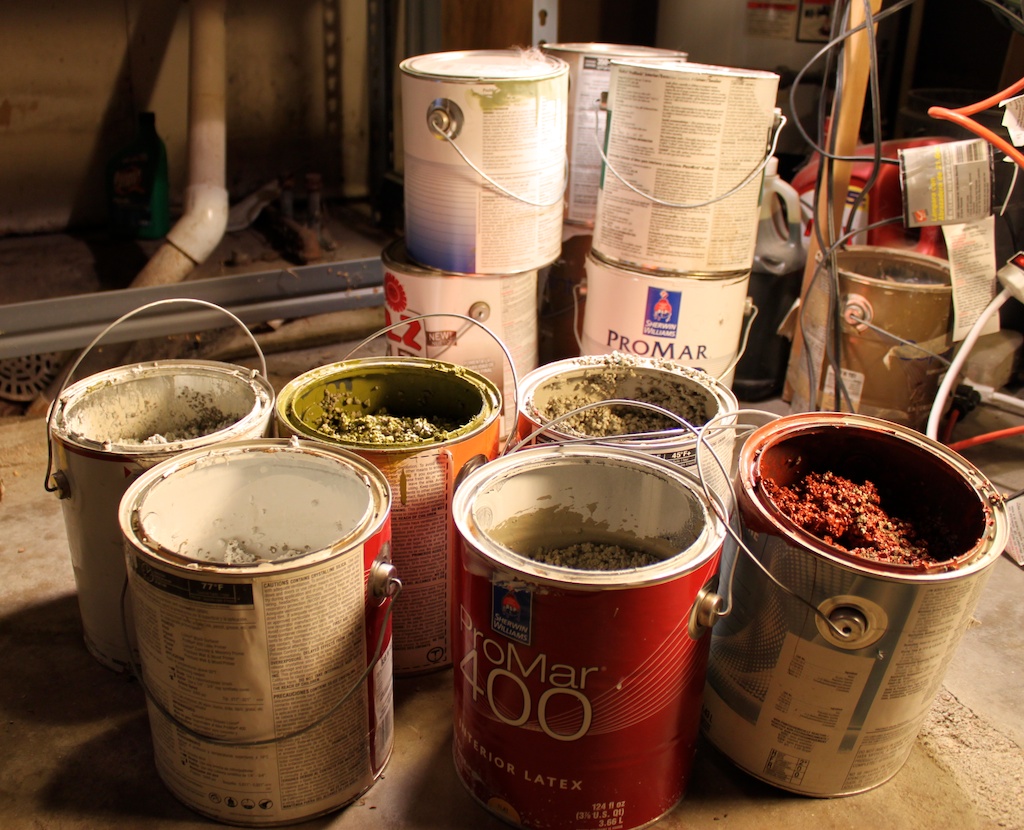
I get asked this question a lot. And I have to deal with it from time to time as well. There are a few good ways to get rid of the old paint you may have lying around in your garage.
Use It Up
The first option you have is to use up the paint.
Mix all of your old paint together and use it to paint stuff like a doghouse, walls that you don't care too much about, the inside of a shed, whatever.
You can also use your new mixture as a primer for your more important projects.
Give It Away
There are a lot of places that might want your old paint. Churches, charities, and other people who are on a tight budget might like it.
Here are some ideas to get you started.
- Churches in the neighborhood
- Charities such as Habitat for Humanity
- Give it away on Craigslist.
- Theatre groups or low budget film-makers
Dry it Up

Finally, if you can't find anyone to take it, you can always just dry it up and throw it away.
Most paints are accepted by your local dump or garbage collection, it just needs to be dried up so it doesn't leech into the ground water or make a mess in the back of the dump truck.
Here is the best way to dry it up fast.
Buy the cheapest kitty litter you can find, or use old saw dust if you have some laying around.
Mix it in with the paint and let it sit over night. By the next morning it will be hard as a rock and you can just throw it away in your normal trash.
For more tips like this, follow Dukes Painting on Twitter!
Add a commentHow to Choose a Roller Cover for your painting project
- Marty Dukes
In this video I discuss the different types and sizes of rollers available to you and how to choose the right one for your painting project. I'll talk about the roller nap or pile, the size of the roller, and a few tips for getting the job done faster.
I recommend that you use brand name rollers such as Purdy, Wooster, or Sherwin Williams. Don't skimp on the roller pad. They are cheap anyway and if you choose the cheapest you will be disappointed in the results.
Add a comment
Should I use an airless paint sprayer to paint my interior walls?
- Marty Dukes
Pam Asks:
We are getting ready to do some more interior painting (we have already done part of the house a number of months ago). Here's my dilemma and I was hoping you could give me some advice. Although we used rollers to do the rooms we've already done, my husband is insisting upon using a power sprayer for the remaining rooms we are getting ready to do. He has never used one before (has used auto paint sprayers, but those are completely different). He just wants to use one now because he thinks it will be less tiresome on his arms than rolling. Last time we painted, I did all the prep work, the taping and masking, and all the cutting in around the trim, and he did all the rolling. And yes, I know it was killer on his arms to do the bigger walls.
But having done quite a bit of research, it seems like using a sprayer for bedroom walls will be more trouble than it's worth. Between the more extensive prep work required when spraying, the time it takes to properly clean and care for the sprayer before and after each time you use it, the learning curve for good application technique, the mess and headache if it doesn't work right, it just seems like a LOT of trouble for painting interior walls. He's not even sure which paint sprayer he should buy and wants me do the research to find one that's inexpensive but will be effective for the purpose we want it
for.
Soooo... from a pro painter's perspective, what do you think? It is worth it for a novice to use a paint sprayer to paint interior walls? I'm trying hard (but in a subtle sort of way) to talk him out of trying to use a sprayer because I sense a messy disaster coming. Should I keep trying to talk him out of it or will it not be as bad as I'm fearing?
Thank you SO much if you take the time to give me your thoughts on this.
Thanks again,
Pam
Marty's Answer:
Hi Pam,
Thanks for thinking of me for the exterior paint work. As for the interior. We don't even spray the walls in an interior of an occupied house. It is possible but the prep required to cover all of the items in the house, the trim, the ceiling, and all of the floors is prohibitive unless you are doing production work. We brush and roll all interior walls unless the house is vacant and we are painting the ceiling and trim as well.
The other thing to note, is that even when we do spray walls, we still have to roll them as well. Its called "back rolling" and you do it as soon as you spray the walls. Just spraying the walls without back rolling will result in a sub par paint job. It is very hard to get a perfectly sprayed latex wall without lots of experience. On flat walls, you will see lines where the spray pattern isn't perfect. On textured walls, you won't be able to get all of the angles without back rolling.
My advice, don't do it. Use a roller. Some tips to make it go faster. Make sure to use an extension pole. Don't use the roller without one. It is much faster and easier on your back if you use a pole. Also, Use a 5 gallon bucket and a roller grate instead of those tiny roller trays. You can fit an entire gallon in the bottom of a 5 gallon bucket. You won't have to refill as much and it will take half the time.
Alternatively, you can use an 18 inch roller and tray. These rollers are twice the size of a normal roller and will get the job done twice as fast.
Marty Dukes - Dukes Painting and Repair - Tulsa Painters
If you have any painting questions, I want to answer them. Contact Us
Add a commentWhat is the best way to paint over walls with cigarette smoke and grease stains?
- Marty Dukes
Devin Asks:
What is the best way to paint over walls with cigarette smoke and grease stains?
Dukes Painting's professional opinion:
This is a tough problem, and one that we deal with all the time. Smoke and grease stains are sinister because they soak into the paint and the substrate. Simply painting over stains like this will do nothing but frustrate you. The stains will seep right back through your new paint. There is a solution, however.
Before you paint you must use a stain blocking primer. Our favorite is Kilz original. The oil based version. There are several versions of this product and they each work a little differently. If you want a one coat fix to this problem you must use Kilz Original, or Kilz Odorless.
There are a couple of downsides to this product that you need to be aware of.
1. It is oil based. Do not spill Kilz or get roller splatter on your floor. It is a pain to get off.
2. You must wear a respirator for application. And get some airflow as well. If you breath the fumes from this product it will make you sick. At first you will feel like you just getting drunk but very quickly the headache will set in. And then your whole day is ruined. Trust me.
Well there you have it. If you have grease stains from the kitchen or smoke stains from years of cigarettes. Just slap on a coat of Kilz before you paint and your problem will be solved.
Add a comment
The one tool every painter should carry
- Marty Dukes
When I was first learning how to paint I had a foreman that was a little bit on the crazy side. He had a lot of rules. If you broke those rules the punishments were steep. For example, if he caught you painting without a drop cloth, you were instantly fired. I saw it happen to a couple of my co-workers. Or shall we say, former co-workers.
Another rule, and the one that this article is about, is that we always had to carry our 5-in-1 tool. "A good painter always has his 5-in-1," he would say. And we always did. And for good reason. A 5-in-1 is sometimes known as a painters tool. and it is the one tool every painter should carry with them at all time.
Scraping
It has innumerable uses. Not just the 5 that the name suggests. Its primary use is for scraping. It is excellent at it. The pointy end is great for getting into those tight spots. Most of the time this is the only tool we will use for scraping a house. with practice it is faster than those two handed scraping tools.
Opening cans
The second most useful thing this tool can do is to open paint cans. Much faster than a screwdriver. It is definitely better than bending up your car keys trying to open that stubborn one gallon can.
Cleaning rollers
A lot of people don't know what the curved, half circle bit on the side of the blade is all about. It is for cleaning out your paint roller. Use it to scrape all the excess paint from your roller back into the can!
Much more
Additional uses include hammering nails, setting popped nails, gouging cracks, killing bugs, removing screws and outlet covers, cutting string, unstick windows, and scratching your butt. Make your life easier on your next painting project and pick up a 5-in-1 tool.
Add a commentMore Articles...
Subcategories
-
Interior Painting
- Article Count:
- 13
-
Exterior Painting
- Article Count:
- 3